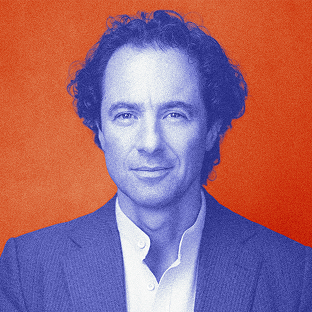
Martin Tisné
CEO and Board Member
Martin Tisné is The Collaborative’s Founder, CEO, and Board Member . He brings over twenty years experience in technology policy to the organisation.
Martin has launched and led several global multi-stakeholder initiatives helping shape global AI and technology governance and policy, and advised and collaborated with governments, civil society, and the private sector at the highest levels. He served as Thematic Envoy to the 2025 AI Action Summit in Paris, leading all deliverables related to public interest AI and founding Current AI, where he serves as Chair of the Board.
Martin has extensive investment and leadership experience, advising heads of state on AI policy, serving as a board member of the Partnership on AI, and having co-founded several global multi-stakeholder initiatives including the Open Government Partnership (with over 70+ country members), the Open Data Charter, and the G20 and G7 open data principles.
Beyond these, Martin has ideated, co-created, and supported organisations shaping AI policy and governance, including AINow, the AWO agency, and Reset Tech.
Before his appointment as CEO of The Collaborative in September 2023, Martin was vice president of the global philanthropic organisation Luminate.
A graduate of Oxford University and the London School of Economics, he is a published author with writings in the Journal of Democracy, MIT Technology Review, Stanford’s Cyber Policy Center, Le Grand Continent, The Stanford Social Innovation Review, and Foreign Policy amongst other publications.
In 2026, Martin was made Chevalier de l’Ordre National du Mérite, presented by President Emmanuel Macron at the Elysée Palace, for his career dedicated to the public interest and ensuring technology serves people.
“I founded The Collaborative for two reasons. First, so that as a field we take advantage of the window of opportunity presented by genAI and bend it to serve the public interest before business models are fully ingrained — learning from our failure to do so with social media in previous decades. Second, I felt frustrated that collectively we had failed to anticipate the ‘AI bursts into public consciousness’ moment with ChatGPT in November 2022. We can do better to prepare for such technological changes and their corresponding impacts on society and democracy.”